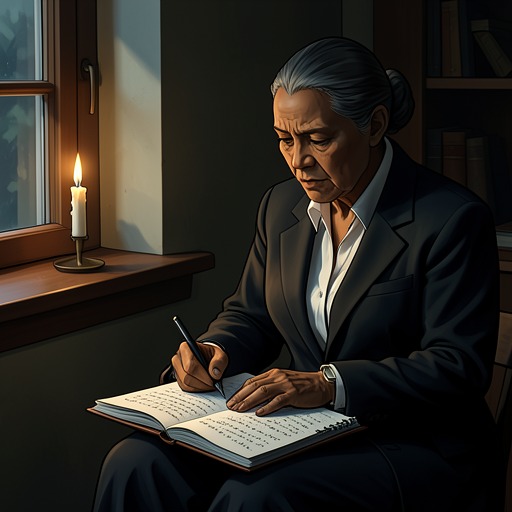
Celie's spiritual crisis and renewal
The Color PurpleCelie’s spiritual crisis and renewal mark a change not from disbelief to simple certainty, but from a God imagined through male power to a divinity encountered in living things. After years of writing to God without feeling heard, she begins writing to Nettie; Shug Avery then offers a different account of God, one that Celie tests against the church’s treatment of women, her own losses, and the overlooked life around her. The renewal remains difficult: male authority does not vanish from her thoughts, but it becomes less able to occupy the whole field of vision.
A Faith Tested by Church and Loss
Celie’s distrust takes shape amid both private suffering and public religious judgment. When Shug is sick and shunned, the preacher uses her condition as the subject of a sermon condemning her as sexually immoral. He does not name Shug, but everyone understands whom he means; the women answer with approving amens. Celie wants someone to defend her. Albert, sitting nearby, says nothing and turns his gaze away. The scene makes religious authority appear aligned with social condemnation rather than compassion for a sick woman.
Celie knows the church from the work she performs there. She cleans its floors and windows, makes wine, washes the altar linen, and supplies wood for the stove, while the preacher praises her faithfulness. That praise does not protect Shug from his sermon or bring Celie the recognition she sees others offer Albert. The contrast helps explain why religious language cannot, by itself, assure her that the God she has been addressing is just or attentive.
The change in her letters gives the crisis a concrete form: Celie writes, “I don’t write to God no more. I write to you.” The new addressee is Nettie, her absent sister. In conversation with Shug, Celie asks what God has done for her and counters Shug’s list of life and love with the losses she can name: a father who was lynched, a mother described as crazy, an abusive stepfather, and a sister she fears she may never see again. She concludes that the God she had prayed and written to is a man, behaving like the men she knows—“Trifling, forgitful and lowdown.” Her accusation is not an abstract dispute about doctrine; it grows out of a life in which male authority has repeatedly failed or harmed her.
Shug’s Account of God
Shug does not answer Celie by defending the church’s image of God. She recalls that she too lost interest when she understood God to be white and male, and she points to the racial limits of religious authority: white people, as Celie knows, do not listen to Black people except to direct them. Shug’s alternative relocates the sacred. God is present within everyone, she says, and may become perceptible through searching or through sorrow, rather than appearing as a distant male figure who grants or denies requests.
In Shug’s account, God cannot be separated from the world and then looked at as an image. She calls God “God is everything,” encompassing what is, what was, and what will be. Her explanation comes from experience: while feeling like a motherless child, she sensed that she belonged to everything rather than standing apart from it. The connection was physical as well as spiritual; she understood that cutting a tree would make her own arm bleed. Shug’s memory gives her theology an embodied basis, joining human feeling to the life of the natural world.
This God is not chiefly concerned with being pleased through obedience. Shug says that God loves what people love, as well as much they do not, and especially values admiration. She imagines creation answering human attention: when people fail to notice the purple in a field, God can make something else. Her formulation, “Everything want to be loved,” places the desire for love across the boundary between human and nonhuman life. It recasts noticing not as a minor courtesy but as a way of recognizing the world’s capacity to give and receive affection.
Learning to Notice
At first, Shug’s explanation does not immediately release Celie from her old picture of God. She admits that she is still adrift and describes how thoroughly the white male image has occupied her attention. In that preoccupation, she has failed to notice even ordinary things: a blade of corn, the color purple, or wildflowers. The list makes spiritual change perceptual and specific. Celie’s renewal begins not with a new institution or a recited formula, but with the possibility of seeing what had been present all along.
As her eyes open, Celie finds that Albert’s evil seems to shrink beside a small bush in her yard, though it does not disappear altogether. That qualification matters: attention to nature does not erase abuse or settle the account of what men have done. It changes the scale on which Albert’s power appears. Shug’s warning that a man must be moved out of the line of sight before anything else can be seen becomes a description of the labor Celie faces, not a claim that the struggle is already over.
Shug describes male authority as an image that tries to seem omnipresent—in food, in people’s thoughts, and over the radio—until it is mistaken for God. She advises Celie to turn instead toward things such as flowers, wind, water, or a large rock. Celie finds the effort hard because the old figure has been in her mind so long and threatens, in her imagination, with lightning, floods, and earthquakes. She says she hardly prays at all and describes throwing the conjured rock. The image makes renewal active and unsettled: attention has to be wrested from the false omnipresence of male power, and even the act of prayer can take the form of resistance.
A Difficult Renewal
Celie’s spiritual change does not depend on Shug supplying a complete explanation that removes every doubt. It develops through a sequence of contrasts: a sermon that condemns Shug against a conception of God rooted in care; an unanswered address to God against a letter to Nettie; a male image that dominates Celie’s vision against the corn, flowers, and purple she begins to notice. Each contrast gives her a way to distinguish divine presence from the authority of men who have claimed to represent it.
The result is renewal without easy absolution. Celie’s attention to nature makes Albert’s evil smaller but not altogether gone, and her effort to dislodge the old image remains difficult. Yet the world no longer has to be read through a male God who resembles the men who have injured or ignored her. Shug’s account lets Celie imagine the sacred as present in herself and in other beings, while the turn toward Nettie keeps spiritual connection bound to human relationship as well as belief. The crisis thus becomes a recovery of perception: not certainty that suffering has been answered, but a widening of what Celie can see and recognize as worthy of love.